reComputer RK3588 Edge AI Computer Overview
Last updated:
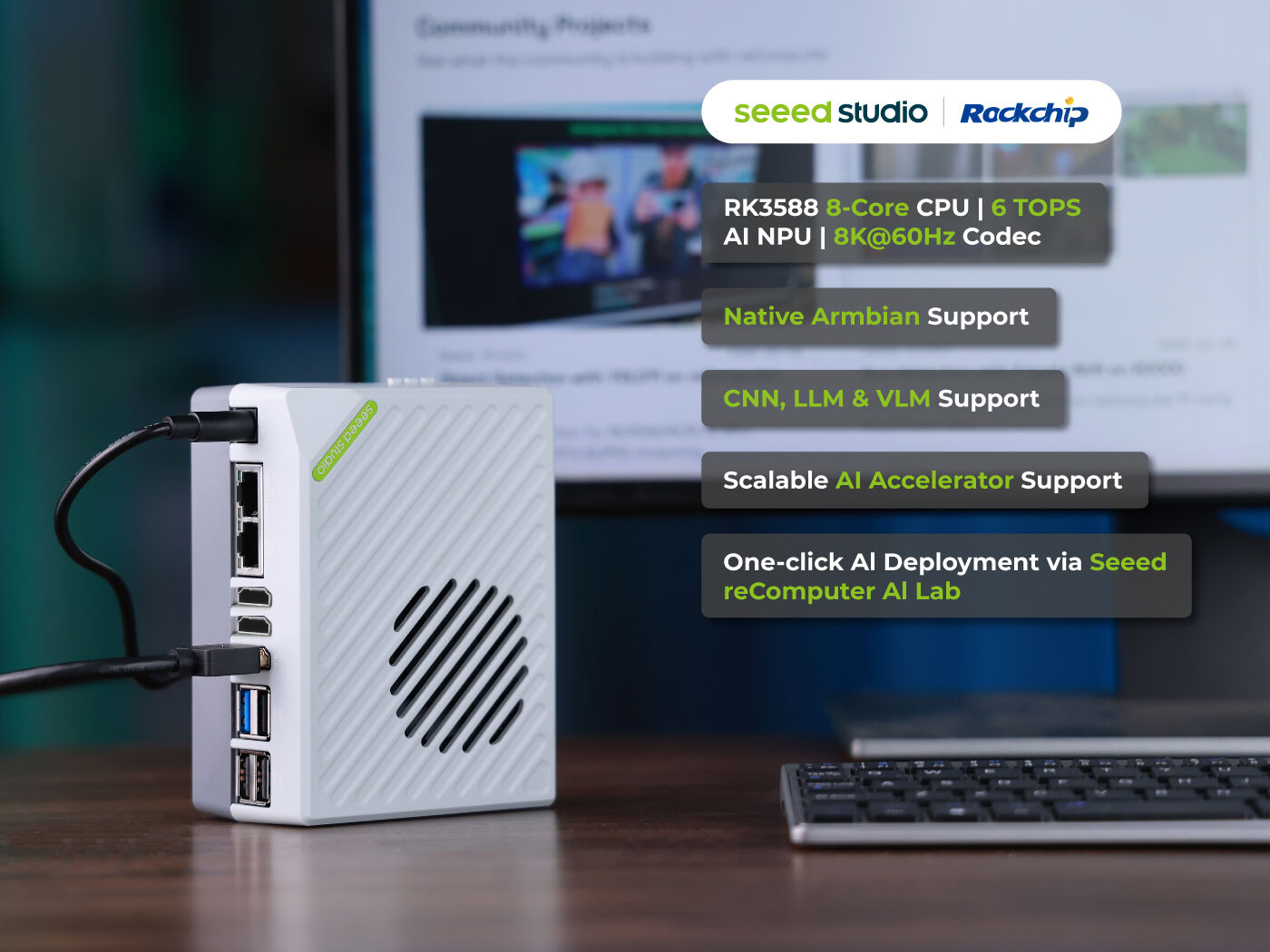
Seeed Studio reComputer RK3588 is a Rockchip-based computer for edge AI application development. Its eight-core, 64-bit CPU combines four Cortex-A76 cores running at up to 2.4GHz and four Cortex-A55 cores running at up to 1.8GHz, alongside an Arm Mali-G610 MC4 GPU and a built-in 6 TOPS NPU for local AI inference and multimedia workloads.
The standard configurations are RK3588-30 with 8GB LPDDR5 and RK3588-40 with 16GB LPDDR5. Custom configurations support up to 32GB. Dual 2.5 Gigabit Ethernet, USB 3.0, display interfaces, and PCIe expansion provide connections for cameras, storage, and peripherals. Armbian comes pre-installed.
The actively cooled AI Box combines processing, networking, storage expansion, and display connectivity in one local computer. Developers can use reComputer AI Lab models and tutorials to build vision detection, voice interaction, multi-display signage, and AIoT monitoring applications.
Features
Processor, memory, and local computing
- Eight-core CPU: The Cortex-A76 / Cortex-A55 combination handles application logic, data processing, and multimedia tasks.
- LPDDR5 memory: Standard 8GB / 16GB configurations and customization up to 32GB let developers select memory for their models and concurrent services.
- Built-in and expandable AI computing: The native NPU provides 6 TOPS of INT8 compute. PCIe can also connect compatible AI accelerators, using their corresponding software and model deployment workflows.
Vision, language, and speech applications
Seeed's official RK series application overview covers:
- Computer vision: Detection, segmentation, face detection, pose estimation, and OCR, with examples such as YOLO, MobileNet, RetinaFace, and CLIP.
- Language and multimodal applications: RKLLM-supported models for local question answering, assistants, and vision-language applications. Official examples include Qwen, DeepSeek-R1 Distill Qwen, and Qwen2.5-VL.
- Voice interaction: Speech-to-text and text-to-speech resources, including Whisper and MMS-TTS.
Select the RK3588 variant on each model page and configure its memory, system image, and runtime requirements. See the benchmark links in the resource download summary for measured performance.
Networking and peripheral expansion
- Dual 2.5GbE: Connect device and management networks separately; one port supports PoE power through an optional module.
- Onboard wireless: Wi-Fi 6 and Bluetooth 5.4 for networking and peripherals.
- Storage and accelerators: PCIe 3.0 ×4 and PCIe 2.1 ×1 connections for NVMe SSDs or AI accelerators.
- Wireless expansion: miniPCIe for optional 4G LTE, LoRaWAN, or Wi-Fi HaLow modules, with a nano SIM slot for use with a cellular module.
Multimedia and multiple displays
RK3588 supports video decoding up to 8K@60fps, encoding up to 8K@30fps, and simultaneous four-display output. The device provides two HDMI 2.1 outputs, one HDMI 2.0 input, and a USB Type-C interface supporting DisplayPort for displays and external video sources.
These interfaces can form a video analytics terminal, multi-display dashboard, or digital signage system. Match video formats, resolutions, and display combinations to the software and peripherals in use.
Armbian and the reComputer AI Lab ecosystem
Armbian comes pre-installed. Seeed's official collaboration with Armbian provides RK series Linux support, and Seeed maintains RK35xx system extensions and an APT package repository.
reComputer AI Lab provides models, deployment tools, tutorials, and projects. RKNN-Toolkit2 workflows convert ONNX models for Rockchip NPU deployment, while application guides provide corresponding container workflows. Find networking, vision deployment, and AIoT guides in the resource download summary.
Specifications
Hardware configurations
| Parameter | RK3588-30 | RK3588-40 |
|---|---|---|
| SoC | Rockchip RK3588 | Rockchip RK3588 |
| CPU | 4 × Cortex-A76, up to 2.4GHz; 4 × Cortex-A55, up to 1.8GHz | 4 × Cortex-A76, up to 2.4GHz; 4 × Cortex-A55, up to 1.8GHz |
| GPU | Arm Mali-G610 MC4 | Arm Mali-G610 MC4 |
| NPU | 6 TOPS (INT8) | 6 TOPS (INT8) |
| Standard RAM | 8GB LPDDR5 | 16GB LPDDR5 |
| Operating system | Armbian | Armbian |
Networking, display, and expansion interfaces
| Interface | Description |
|---|---|
| Ethernet | 2 × 2.5 Gigabit Ethernet; one port supports PoE with an additional PoE module |
| Wireless | Onboard Wi-Fi 6 and Bluetooth 5.4 |
| USB | 4 × Type-A USB 3.0; 1 × Type-C for OTG and DisplayPort |
| HDMI | 2 × HDMI 2.1 outputs; 1 × HDMI 2.0 input |
| Storage / accelerator expansion | PCIe 3.0 ×4 and PCIe 2.1 ×1 for NVMe SSD or AI accelerator expansion |
| Wireless expansion | miniPCIe for optional 4G LTE, LoRaWAN, or Wi-Fi HaLow modules |
| microSD | 1 × microSD slot |
| SIM | 1 × nano SIM slot |
System and multimedia
| Item | Description |
|---|---|
| Power input | 9–19V DC |
| Cooling | Heatsink with fan |
| Buttons | 1 × Power; 1 × Recovery; 1 × MaskROM |
| LEDs | 1 × Power; 1 × Status; 1 × User |
| Buzzer | 1 |
| RTC | 1 × 2-Pin header |
| Video decoding | Up to 8K@60fps |
| Video encoding | Up to 8K@30fps |
| Multiple displays | Simultaneous four-display output |
Environment and other information
| Item | Description |
|---|---|
| Operating temperature | 0–55°C |
| Storage temperature | -20–90°C |
| Operating humidity | 10–95% RH |
| Certifications listed by Seeed | FCC, CE, TELEC, RoHS |
| Warranty | 1 year |
The 32GB memory configuration is a customization option. PoE and wireless expansion modules are additional accessories; select the configuration and accessories for your deployment.
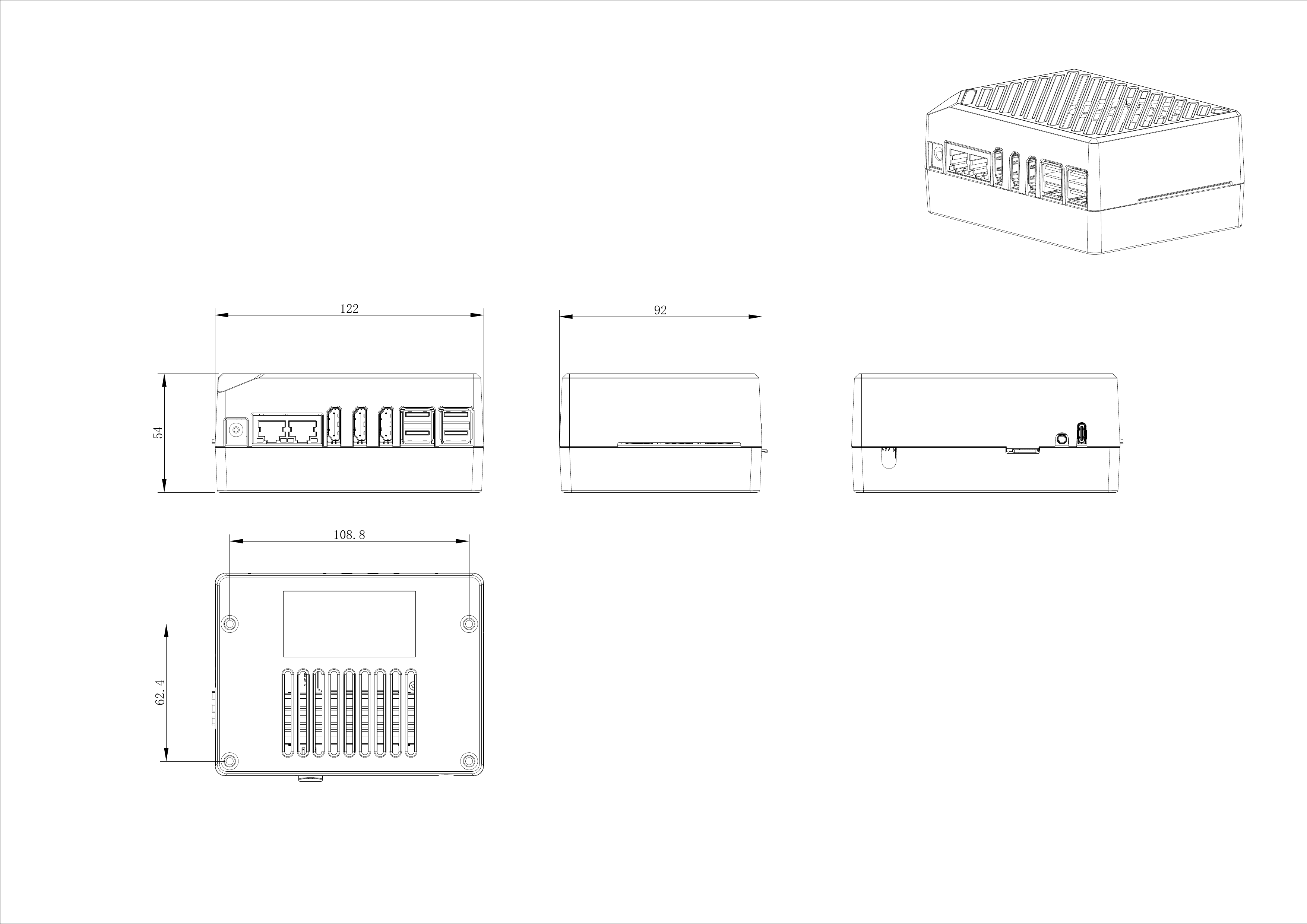
Dimensions
The drawing labels the enclosure as 122 × 92 × 54 mm, with bottom mounting-hole spacing of 108.8 × 62.4 mm.