reComputer Jetson Platform Overview
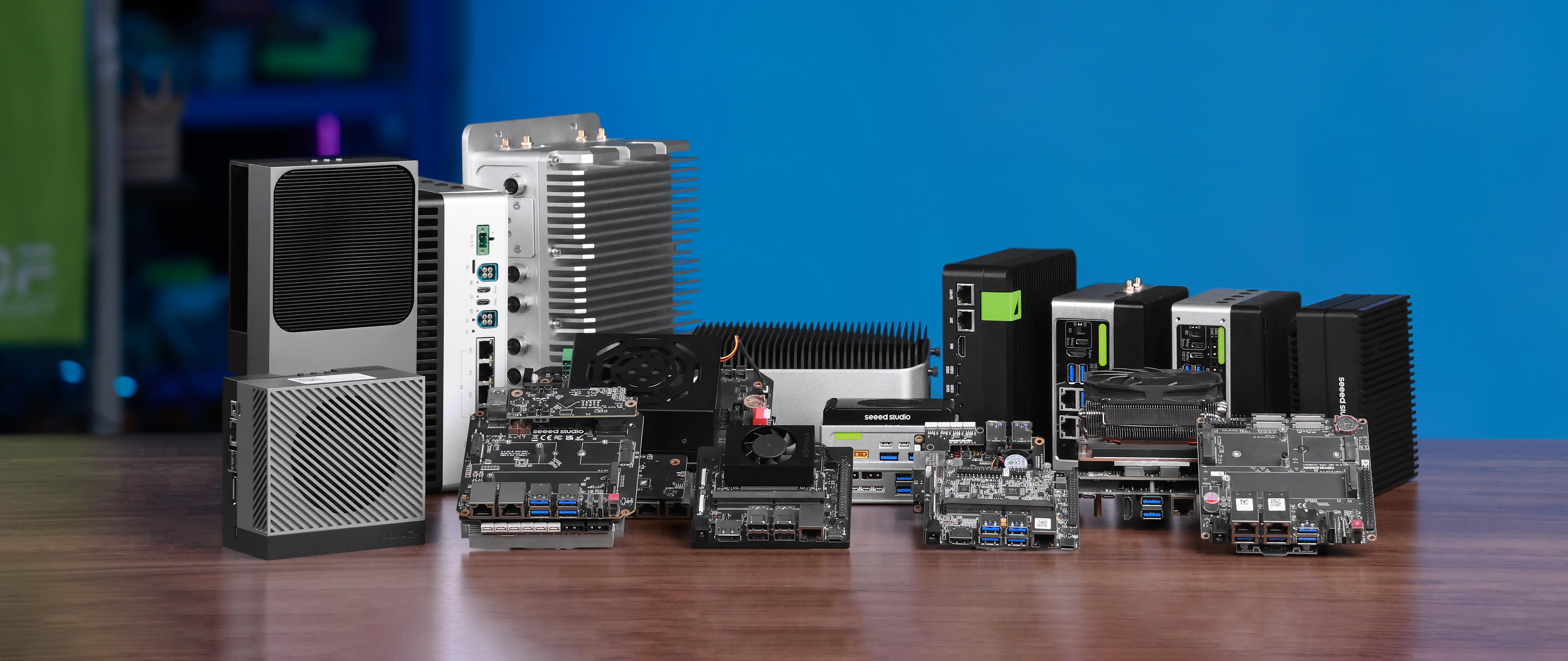
This chapter answers one core question: what exactly is Seeed's reComputer Jetson platform, and how does it relate to NVIDIA Jetson modules, carrier boards, full systems, and the software stack?
#Why This Chapter Matters
Before diving into JetPack, CUDA, TensorRT, and the AI projects in later chapters, it helps to separate three layers clearly:
Jetson module: the compute core provided by NVIDIA, including the CPU, GPU, NPU, memory, and other core processing resources.carrier board: the platform provided by Seeed that exposes interfaces such as USB, CSI, Ethernet, CAN, and M.2.full system: a deployable edge AI device built by combining the module and carrier board with thermal design, storage, enclosure, power, and BSP support.
#Chapter 2 Outline
| Module | Topic | What You Will Learn |
|---|---|---|
| Module 2.1 | What Is reComputer Jetson | Understand that reComputer is not a single model, but a product family built around Jetson SoMs |
| Module 2.2 | NVIDIA Jetson Module | Understand the positioning differences between Orin Nano, Orin NX, AGX Orin, and Xavier NX |
| Module 2.3 | Seeed Jetson Compatible Carrier Board | Compare how different carrier boards emphasize different IO, power, and expansion capabilities |
| Module 2.4 | Jetson Full System Series | Understand Seeed's product matrix through the Classic, Mini, Industrial, Super, and Robotics full-system families |
| Module 2.5 | Accessory Support | Learn the common accessories, interface types, and software ecosystem around reComputer Jetson |
#Learning Goals
After this chapter, you should be able to answer:
- Why
TOPSis not the only metric that matters when choosing a platform - Why the same
Jetson Orin NXcan appear in multiple Seeed product families - Why some scenarios prioritize
serial / CAN / dual Ethernet / 5G / GMSL2more than raw compute alone - Which type of reComputer is a better fit if your goal is to learn JetPack and basic AI inference
#Suggested Reading Order
It is recommended to read this chapter in the following order:
- Start with
2.1to build the overall mental model. - Continue with
2.2to understand the NVIDIA Jetson module lineup. - Read
2.3and2.4to distinguish carrier boards from full-system product families. - Finish with
2.5to connect interfaces, accessories, and the broader platform ecosystem.